This sermon was preached on Sunday 22nd October 2023 at All Saints Church, Oakham.
Matthew 22:15-22
This Wednesday marks four years since Cecily and I went for our first date together. We went for lunch at the Rose Tree pub in Durham. Now there a lot of topics that people say you should avoid on a first date. Money, politics and religion usually top the list. They can be subjects that make us feel very uncomfortable. Of course, there are many other topics that would produce the same uncomfortable awkwardness which are worth avoiding. Talking about marriage on a first date is usually a bit intense, and talking only about past relationships isn’t a great opener for a first date. I can see some of you shift in your pews a bit as I say this. Another topic that is sure to crash and burn any first date or any meeting for that matter is taxes. Your reactions show you agree with me.
You have heard that it was said, ‘in this world nothing can be said to be certain, except death and taxes.’ Despite using the classic opening words from Jesus, it was in fact US Founding Father, Benjamin Franklin who said this in a letter to French physicist Jean-Baptiste Le Roy in 1789. I personally feel that Franklin is being slightly cynical with this phrase, however, he is right in observing the eternal and present nature of taxes in our society.

Taxes or a form of taxation be it financial, material or emotional etc. have always been a part of life that can and will divide people. The time of Jesus was no different went it came to taxes. Our gospel reading today demonstrates this as the Pharisees tried to entrap Jesus by using the controversial topic of taxes. They knew taxes were a difficult topic anyway, but they carried another layer of complexity as the Jews were under Roman occupation and their taxes went not paid to a Jewish king, but to a Roman Caesar.
The Pharisees come to Jesus and say, with false flattery, ‘Teacher, we know that you are sincere, and teach the way of God in accordance with truth, and show deference to no one; for you do not regard people with partiality. Tell us, then, what you think. Is it lawful to pay taxes to the emperor, or not?’
This is a tough question for Jesus. It places him between a rock and a hard place. If he says it is lawful to pay taxes to Caesar, then he is turning against the Jewish people and rejecting the notion of God as the true king and ruler of the Jews. However, if he says it is not lawful to pay taxes to Caesar, then he can be tried by the Romans as a stirrer of revolt and treason against Caesar and the Roman empire. Either side would be a sure-fire way to end Jesus’ ministry and potentially his life.
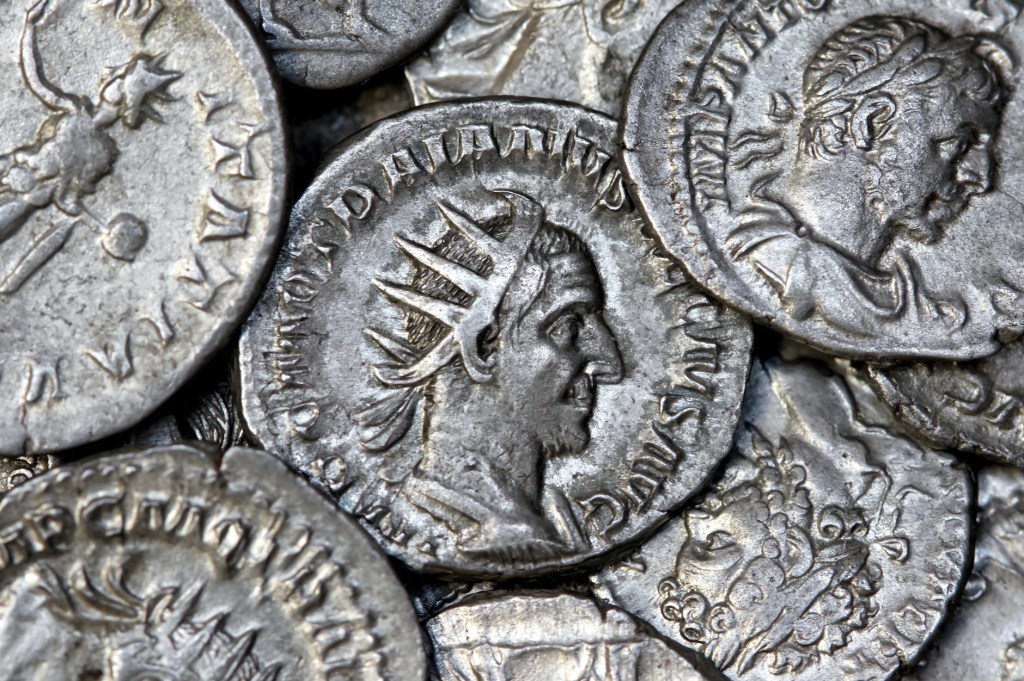
‘But Jesus, aware of their malice, said, ‘Why are you putting me to the test, you hypocrites? Show me the coin used for the tax.’ And they brought him a denarius. Then he said to them, ‘Whose head is this, and whose title?’ They answered, ‘The emperor’s.’ Then he said to them, ‘Give therefore to the emperor the things that are the emperor’s, and to God the things that are God’s.’ When they heard this, they were amazed; and they left him and went away.’
Jesus, in his all too typical way, doesn’t answer the question he is asked but asks his own question in return. This is both a classic tool of rhetoric, and it allows Jesus to frame the narrative of the topic on his terms, not the Pharisees. The Pharisees are thinking about the Jews and Romans, as though they are two parts of this dichotomy. However, Jesus reframes it to make it a dichotomy between earthly rulers, like Caesar, and God, the heavenly ruler.
If you look at a bank note, you will notice that along the top it says ‘I promise to pay the bearer the sum of ten pounds’ or five or twenty, or fifty if it’s a good day. Now who is saying this? It’s not Sarah John, the Chief Cashier of the Bank of England, it is the Queen who is saying it, or come next year, King Charles who is saying it. It is his promise that as head of state, this money in his realm carries meaning.

So when Jesus asks ‘whose face is on this coin?’ He is pointing to how Caesar, the emperor, is the head of state. Money was issued and licensed in the Roman Empire by him. It shows that all money at the time came from Caesar, and so it is right to say, give to Caesar what is Caesar’s. He is the great earthly ruler.
However, Jesus contrasts this with God, the great heavenly ruler, which the Pharisees know. He asks them, ‘what is God owed?’ As the heavenly ruler of all of creation, what is he owed? If everything in creation is his, then God is due everything. That includes us. God is due our finances, our time, our energy, our work, our relationships. Everything. God is the God of everything. So, when we talk about giving God his due, we are talking about giving God his everything.
So when we hold the dichotomy of giving to Caesar what is Caesar’s, and God what is God’s, we look to give each their proper due. Give what is right to Caesar, or in our case in the UK, give to King Charles what is his due as our earthly king. Jesus doesn’t say give if you feel like it, he says give. But also, we are to give ultimately to the highest authority, that is God.
Paying taxes or our due in life is never fun, but it is something that is part of life, and something that God calls us to do willingly. However, if you find this uncomfortable, remember that all our earthly taxes sit under the greater authority of our God in heaven, who made heaven and earth, and so is due everything in heaven and earth.

My question to you today is: how are you going to give to your earthly taxes and to your God in heaven? Are you giving God your everything? You may give him some time on a Sunday but is he getting the rest of your week? You might be giving to church, but are you using the rest of your money in a way that doesn’t honour God? You try to live like Jesus on Sunday but come Monday you are being hateful and slanderous at work.
God is due our everything so, give him your everything.
Amen
 Shakeel Nurmahi